Identity manifest
Artwork, authority, lifecycle and versioned resources.
A working artistic and technical experiment
What if a historical figure or a painting could speak in a voice of its own, retain a recognised identity and continue as its technology changes?
Explore the ideaMary Somerville prototype · local conversation grounded in historical sources
The encounter
A visitor can meet a historical figure through sources and conversation, or encounter a painting through an animated digital counterpart. Each can listen, consider and respond. The technology extends the encounter without pretending to replace the person or the artwork.
01AI provides interaction. Conversation, perception and speech can run locally at an exhibition or through a hosted service.
02Sources shape the character. Historical records or artist-approved material define what it should know and how it should respond.
03Identity provides continuity. The recognised subject, its revisions and its resources need not depend on one model or operator.
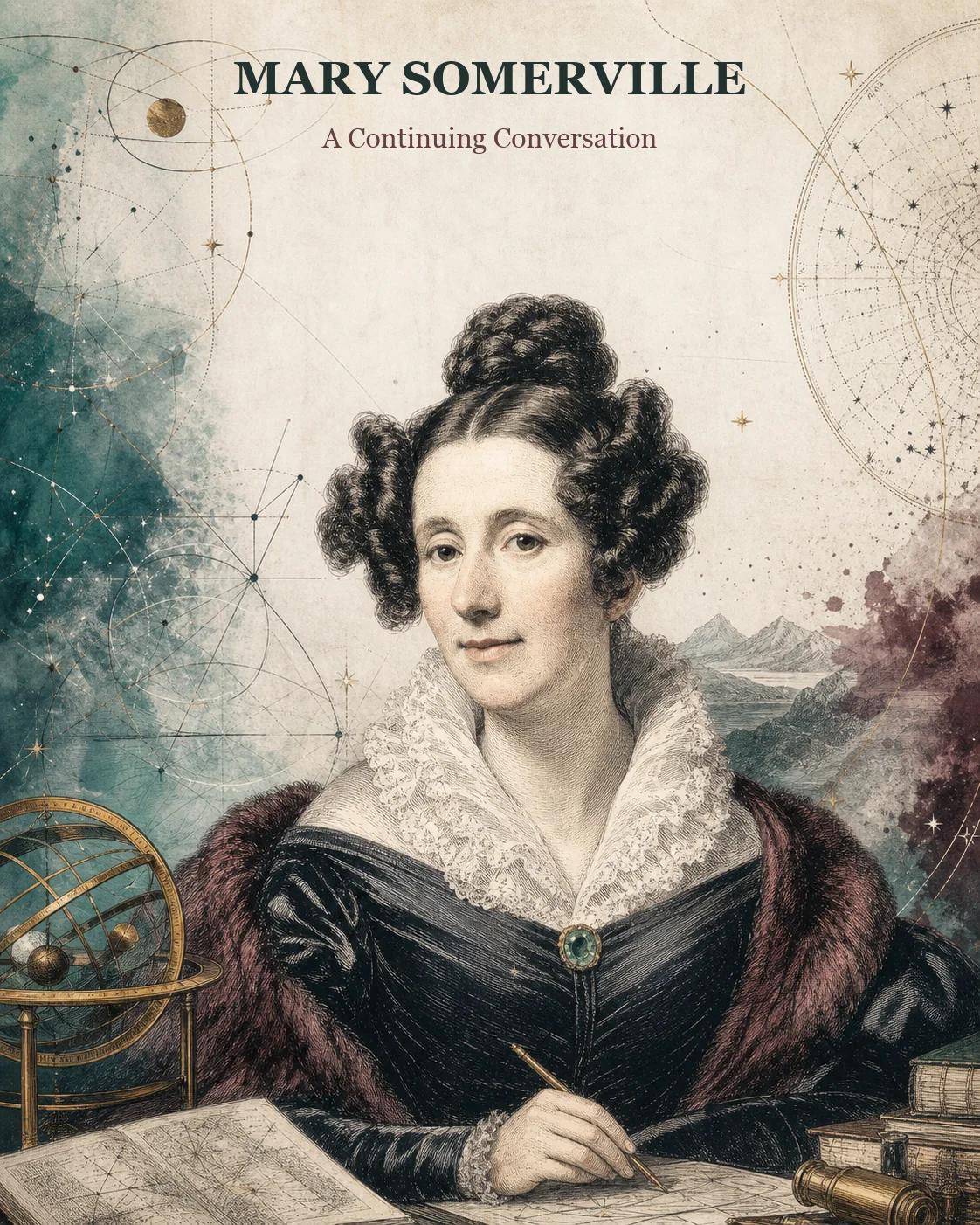
Three reference subjects
A source-grounded historical interpretation drawing on Personal Recollections and other reviewed material. It tests evidence, uncertainty, citation and private local inference.
A developing historical interpretation grounded in six published primary works. It tests how a public intellectual can be explored without inventing a private voice the record cannot support.
An animated conversational counterpart shaped by material from the artist. It tests how artistic intent, collector ownership and exhibition operation can remain distinct.
All three have working reference implementations at different stages. This project site does not currently host their live conversational runtimes.
Current reference
Mary Somerville is the first independently resolvable Intelligent Living Art identity deployed on Sepolia.
Her token records a verified creator, current owner, identity revision, operational manifest and permanent ERC-6551 account. The reference resolver can verify those bindings and plan compatible hosted, offline, personal-provider and presentation-only ways to run the identity.
The onchain identity is live; Mary's conversational website is not yet publicly deployed.
The contracts remain experimental and unaudited. The resolver's public API-backed deployment is being withheld until its catalogue, fetch policy and disclosure boundaries have been reviewed. The testnet work is evidence that the architecture can be exercised, not a production claim.
Beyond the conversation
Chat is the visible part. The harder question is whether the recognised identity, authority and resources of a character or artwork remain verifiable as services, operators and owners change.
In the Ethereum prototype, an ERC-721 acts as a digital passport and ERC-6551 gives it an account. For a living artist’s work, the artist can shape the canonical character without controlling the collector’s property. The owner can choose its recognised operator and manage spending without rewriting the artwork’s meaning.
Mary now supplies the first testnet proof of that separation: a creator-confirmed historical interpretation, an owner-controlled operational manifest and a permanent token-bound account can be resolved without treating the conversational service itself as the identity.
Anyone may still construct a compatible independent experience from permitted public material. Ownership controls the canonical wallet and operating configuration; it does not grant a monopoly on interpretation or software. For Mary, the equivalent authority is careful use of historical sources and clear boundaries around what can be claimed in her voice.
Built with boundaries
Conversation is off-chain. Private dialogue and raw camera material do not belong in a public permanent record.
Recognition is not the baseline. Persistent visitor identification is deliberately excluded.
Models are qualified by use. LLMs and VLMs are tested for facts, false premises, character and visual invention before canonical deployment.
Proposed spending is constrained. The experimental conversation-fund contract separates contributions and service budgets from valuable identity assets; it is not deployed for the Mary reference.
A wider field
Museums and researchers have already created source-grounded historical characters, conversational objects, voiced exhibition figures and digital humans. Intelligent Living Art builds within that developing field rather than claiming to have invented it.
The National Gallery of Denmark and the Technical University of Denmark made the sources and constructed nature of an Anne Marie Carl-Nielsen chatbot visible.
The Met and OpenAI used letters, newspapers and historical documents to create a conversation around Natalie Potter's wedding ensemble.
Fondazione Einaudi and Reply built a voiced 3D digital human from a curated corpus of Luigi Einaudi's original writings.
Joseph Lister research tested a historical character for evidence, temporal limits and voice, while still finding occasional invention and slippage.
Intelligent Living Art is testing whether identity, evidence, rights, limitations and authority can form a portable, versioned package that more than one compatible application can inspect. Its optional Ethereum layer records which identity and authority are recognised across changing software; it does not certify that an AI-generated statement is historically true.
Origins
David Oxley’s interest in NFTs grew while developing a new website for Edinburgh artist Trevor Jones and engaging with Trevor’s exploration of cryptoart.
The former DeCaDE Centre for the Decentralised Digital Economy was another influence. Its wider work covered decentralised digital economy questions; the relevant strand here is ORA and ORAgen. Using provenance, rights metadata and smart contracts, those projects explored how digital assets could be licensed and how attribution and reuse could leave a verifiable trail. Intelligent Living Art is an independent project taking that interest in programmable identity and continuity in a different direction.
How it fits together
The architecture separates the subject’s identity from conversation, storage, payment and any particular AI provider.
Open the full poster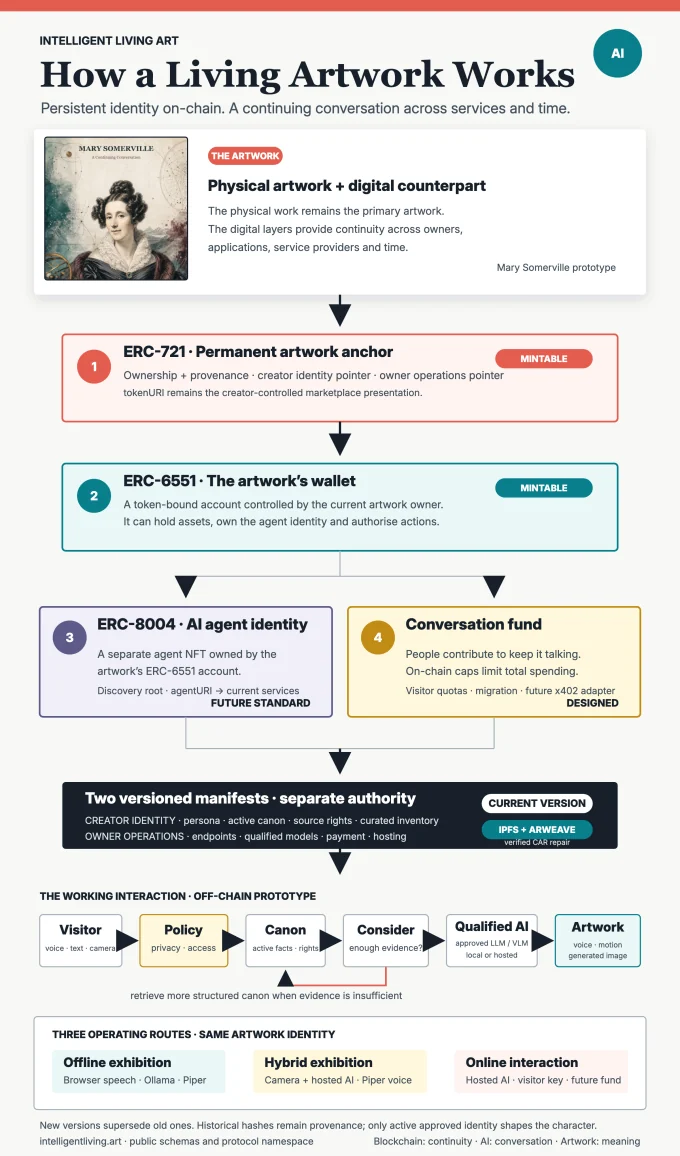
For builders and researchers
Machine-readable schemas let another application inspect the same identity, rights and operating boundaries or construct a clearly labelled independent interpretation.
Artwork, authority, lifecycle and versioned resources.
Presentation, grounding, memory, inference and fallback.
Rights-aware knowledge sources and retrieval locations.
Reproducible LLM and VLM tests, review and scoped approval.
Accepted, hidden and quarantined wallet-held assets.
Verified IPFS, Arweave and local restoration rules.
Discovery, authority checks and verified linked resources.
Compatible hosted, offline and personal-provider runtime choices.
Speech-safe punctuation, citations and pronunciation without changing displayed text.
Ordered, consent-aware camera, image, speech and presentation actions.
Read the current technical specification for implemented components, Mary’s Sepolia deployment, authority rules, privacy boundaries and remaining production work.